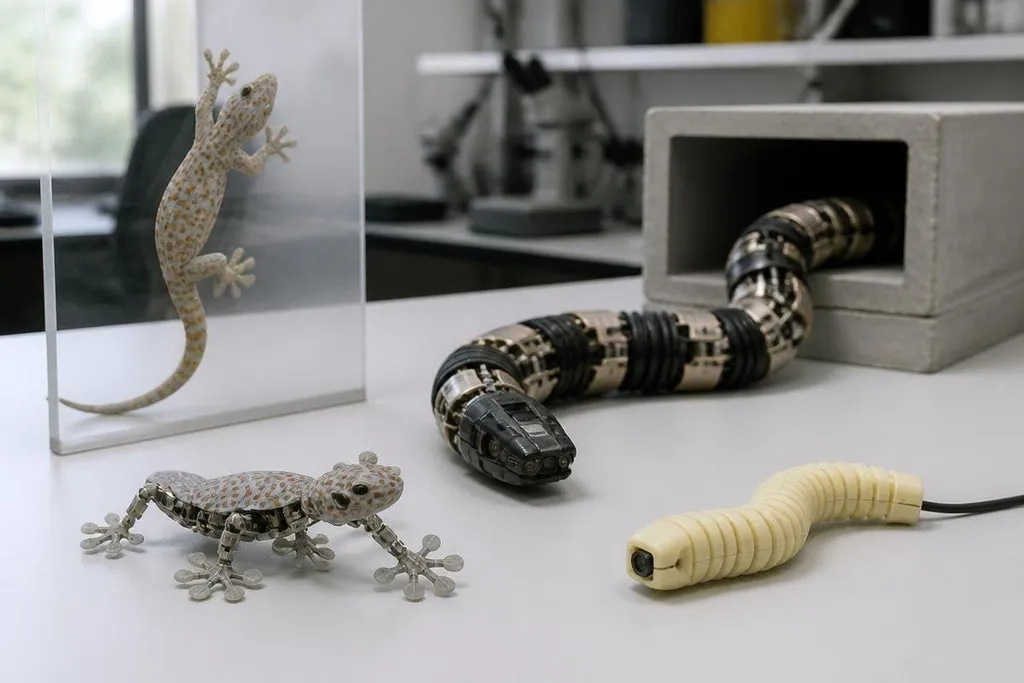
A gecko can grip a wall without glue. A snake can move through a narrow gap without legs. These natural systems give robot designers working ideas for surfaces, joints, movement, and control.
- Geckos show how dry adhesion can replace suction cups or magnets.
- Snakes show how a robot can move through tight, uneven spaces.
- Octopuses show how soft arms can handle objects without rigid joints.
Nature gives engineers mechanisms to study
Bio-inspired robotics starts with a physical problem. A robot needs to climb, turn, grip, or move over rough ground, so its designers look for an animal that already handles that task.
The goal isn't to copy an animal's full body. A robot may borrow one useful feature, such as a gecko's dry grip or an insect's leg layout, then pair it with motors, sensors, and software.
Gecko feet are a useful example. Their toes contain tiny structures that create contact across a surface. A robot based on that idea could hold onto glass or painted walls without leaving liquid behind, though the surface must stay clean enough for the contact to work.
That limit matters in inspection work. Dust, oil, loose paint, and rough concrete can reduce the grip, so a wall-climbing robot needs a way to check its contact before it moves.
Movement changes with the terrain
Animals also show that one movement pattern rarely works everywhere. A snake can bend its body around obstacles, while a six-legged insect can keep moving when one leg loses contact.
Snake robots use linked joints to create waves along their bodies. Those waves can push against the ground and move the robot through pipes, rubble, or narrow passages where a wheeled platform may have trouble turning.
The same design brings a cost. Each joint adds a motor, cable, seal, and control problem. A long snake robot can reach places other robots cannot, but it may take more time to set up and repair.
Insect-like robots use several legs to spread their weight across the ground. The control system can change the timing of each leg as the surface shifts. That helps on loose soil or broken ground, but it also means more parts must move in the right order.
A lab model matters more once a robot has to cross soil, carry a load, or work around real obstacles. Robot24.com’s robotics reporting can connect that design to a named machine and task before the focus shifts to soft bodies.
Soft bodies solve a different problem
An octopus has no rigid skeleton in its arms. That lets an arm bend around an object and change its shape during contact. Robot makers use the same idea in soft grippers made from flexible materials.
A soft gripper can handle fruit, fabric, or other objects that may bruise under a hard clamp. Its shape spreads contact over a wider area, so the robot needs less exact positioning before it closes its grip.
Soft parts still have limits. They can tear, lose force as they wear, and make it harder to know the exact position of the gripper. A factory that needs repeatable placement may prefer a rigid arm with a known reach and payload.
Bird wings offer another lesson. A wing changes its angle and shape as it moves through air, so flying robots need more than a fixed propeller if they want to copy that motion.
Flapping systems can be useful for small aircraft, but they bring moving parts and control work that fixed wings avoid.
What to check before buying a bio-inspired robot
The animal reference can explain the design, but it cannot prove that the robot fits your job. Check the machine itself:
- Surface contact: Ask which materials the feet or gripper can handle, and how dirt affects grip.
- Movement space: Measure the smallest passage, turning area, and floor slope the robot must cross.
- Payload: Check the rated load at the robot's actual reach, not only the best case.
- Maintenance: Count motors, seals, flexible parts, and access panels that technicians will service.
- Control method: Find out which tasks run on the robot and which still need teleoperation.
- Field evidence: Ask for an uncut task video, deployment details, or test results from a similar site.
Nature helps designers find useful answers, but it doesn't remove the engineering work. A gecko-inspired foot still needs testing on the wall you have, and a snake robot still needs enough joint power for the pipe it must cross.
I think the best bio-inspired robots borrow one proven mechanism and state its limits plainly. The next useful question is not which animal a robot resembles, but whether that borrowed feature keeps working after dust, wear, and a full work shift.